

Our story
Years of Living Beauty
The coral trees of San Vicente Boulevard are more than street trees — they are a living archive of Santa Monica and Los Angeles neighborhood life.
How It All Began
For decades, Pacific Electric Red Cars traveled along the center of San Vicente Boulevard. After the trolley tracks were removed, the former right-of-way was transformed into a broad, grassy median. The community resolved to plant trees where the tracks had once run, and beginning in 1949, coral trees were planted along the boulevard.
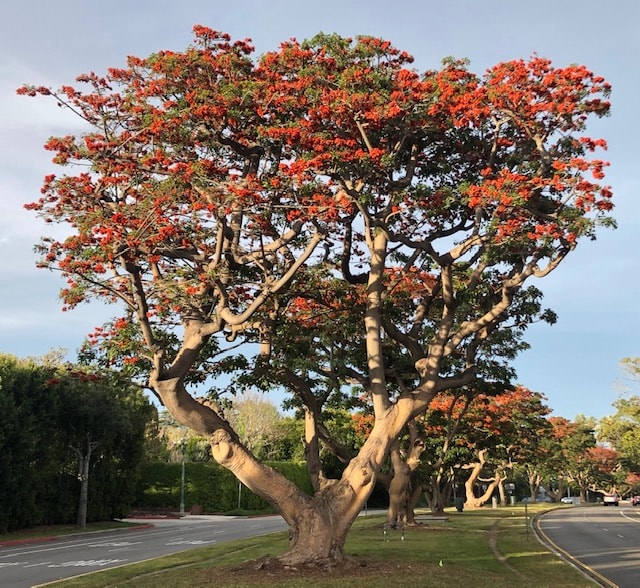
Horticulturist Samuel Ayres, Brentwood businessman David Barry Jr. and nurseryman Hugh Evans are credited with persuading the City of Los Angeles to plant Erythrina caffra, the South African coral tree. Over the following decades, the young trees grew into a magnificent corridor extending through Brentwood and Santa Monica. Their spreading branches, sculptural trunks and brilliant coral-red blossoms created one of the region’s most distinctive and beloved streetscapes.
Know the tree
Erythrina caffra
South African Coral Tree
A living history
Timeline of the Trees
From Railway to Greenway
Pacific Electric Red Cars once traveled along tracks in the center of San Vicente Boulevard. After the tracks were removed, the former railway right-of-way was transformed into a broad, grassy median used by the community for walking, recreation and even horseback riding.
The Coral Trees Are Planted
The community resolved to plant trees where the railway tracks had once run. Horticulturist Samuel Ayres, Brentwood businessman David Barry Jr. and nurseryman Hugh Evans helped persuade the City of Los Angeles to plant South African coral trees along the boulevard.
A Living Canopy Emerges
Over the following decades, the young trees grew into a sweeping corridor of sculptural trunks, arching branches and brilliant coral-red blossoms. The canopy became an enduring symbol of San Vicente Boulevard and the communities it connects.
Los Angeles Adopts the Coral Tree
The City of Los Angeles designates the coral tree as its official city tree, recognizing its special place in the landscape and identity of Los Angeles
Historic Recognition
The Brentwood portion of the coral tree corridor, extending from 26th Street to Bringham Avenue, is designated Los Angeles Historic-Cultural Monument No. 148.
Protecting the Entire Historic Corridor
The community is pursuing historic designation for the Santa Monica portion of this landmark landscape, helping protect the complete coral tree corridor as it was originally conceived: “from the Soldiers’ Home to the sea.”
Documentary
The Trees on Film

Watch on California Revealed
Opens in a new tab ↗
Why These Trees Matter
The coral trees are not simply trees planted along San Vicente Boulevard. Together, they form a historic cultural landscape that has shaped the identity of Santa Monica and Brentwood for generations. Their arching branches, sculptural trunks and brilliant coral-red blossoms transform an ordinary roadway into one of Southern California’s most memorable streetscapes.
The coral trees are not merely part of San Vicente Boulevard. They are what make San Vicente unforgettable.